LPG Market Report
18 August 2026
Market Snapshot
Asian LPG markets remain volatile into the second half of August, with the focus increasingly shifting towards September CP and September delivery pricing. August Saudi Aramco CP was fixed at USD 620/MT propane and USD 640/MT butane, both USD 40/MT higher than July. (Mizanest)
Despite the August CP increase, the forward curve is currently pointing towards a lower September CP, particularly for propane.
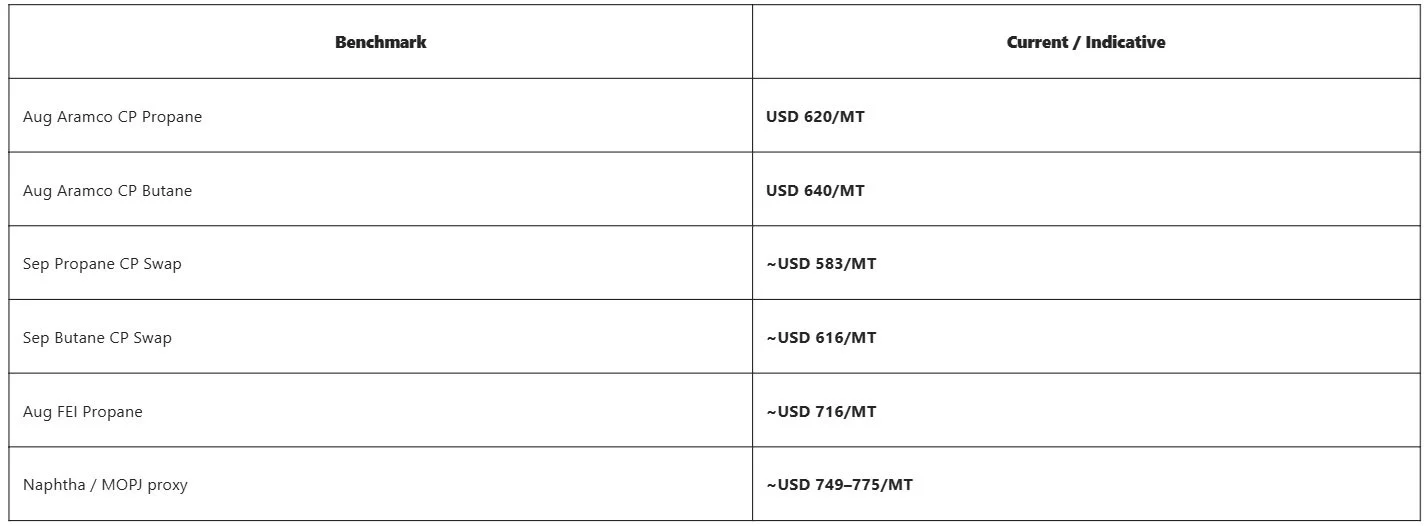
September Saudi propane swaps were around USD 583.38/MT on 17 August, approximately USD 37/MT below August CP. September butane CP futures are around USD 616/MT, also below August CP. (Barchart.com)
September CP Outlook
Based on the current forward market, our working indication for September CP is:
Propane: USD 580–590/MT
Butane: USD 610–620/MT
This would represent a correction of approximately USD 30–40/MT for propane and USD 20–30/MT for butane versus August.
The propane curve is showing the clearer downside signal. US propane prices have also softened over the past month despite a rebound on 17 August, while global LPG supply has recovered from the severe disruptions earlier this year. (Trading Economics)
However, Middle East geopolitical risk remains capable of producing sharp short-term moves, so September CP remains sensitive to any renewed export or shipping disruption.
FEI / Far East
August FEI propane futures are trading around USD 715–716/MT, leaving FEI substantially above Saudi CP. (TradingView)
The premium reflects both delivered freight economics and continued Asian buying requirements. July also ended with the FEI propane market in backwardation, with the balance-month/month-one spread around USD 22/MT, indicating relatively stronger prompt demand. (General Index)
The key question moving into September will be whether Asian demand can sustain FEI at current levels as CP rolls lower. A softer CP without a corresponding drop in FEI would improve the economics of Middle East barrels delivered into Asia.
MOPJ / Naphtha
Asian naphtha remains relatively expensive. Spot naphtha was around USD 749/MT on 17 August, while SGX CFR Japan naphtha futures were around USD 775/MT. (Trading Economics)
At these levels, LPG remains competitive against naphtha for flexible crackers, particularly if September propane CP moves towards the high-USD 580s.
The LPG/naphtha discount could therefore widen into September, potentially encouraging additional LPG cracking demand and providing some support to FEI despite softer CP.
VLGC Freight
VLGC freight remains elevated but the forward curve points towards some easing.
For BLPG1 Middle East Gulf–Japan, August futures have been indicated around USD 144/MT, while September is around USD 123/MT and October around USD 117/MT. (CME Group)
This suggests the market expects the current freight tightness to moderate as tonnage positions normalise.
Direction:
BLPG1: Firm prompt / softer forward
BLPG2: Elevated but volatile
BLPG3: Firm, with US–Asia economics highly sensitive to FEI–Mont Belvieu arbitrage
A softer freight market would improve US and Middle East LPG economics into Asia and could place additional pressure on regional physical premiums.
Pressurised LPG
The Asian pressurised market remains comparatively quiet, with requirements continuing to emerge on a cargo-by-cargo basis rather than through sustained programme demand.
For 5,000–7,500 CBM, Southeast Asian coastal and short-haul business remains the more active segment, while larger 10,000–11,000 CBM ships continue to depend heavily on positional opportunities and backhaul employment.
Owners are still reluctant to discount aggressively where tonnage is tightly positioned, but charterers have greater negotiating leverage where ships face open positions.
Current tone:
5K CBM: Steady
7.5K CBM: Steady / slightly soft
11K CBM: Softer where vessels need employment
Southeast Asia short-haul: Selective activity
North Asia: Relatively quiet
China
China remains the key swing demand centre.
PDH economics and operating rates will continue to determine incremental propane demand. With FEI still relatively high, buyers are expected to remain price sensitive. However, the combination of a potentially lower September CP and expensive naphtha could improve LPG feedstock economics.
A meaningful recovery in Chinese PDH buying would quickly provide support to FEI and physical premiums.
Near-Term View
Overall bias: Neutral to slightly bearish CP / cautiously constructive Asian demand.
The market is presently showing two competing forces:
Bearish
September CP forwards below August levels
Increasing global LPG availability
Potential easing in VLGC freight
Price-sensitive Chinese demand
Supportive
High Asian naphtha prices
LPG becoming more competitive as cracker feedstock
FEI maintaining a substantial premium to CP
Continuing geopolitical and shipping risks
Atlas View
We expect September propane CP around USD 580–590/MT and butane around USD 610–620/MT based on the present forward curve.
The more interesting development is the widening discount of propane against naphtha. If MOPJ remains around the mid-USD 700s while propane CP falls towards USD 580–590/MT, LPG cracking economics should improve materially.
For shipping, VLGC freight looks likely to ease from August highs, while the pressurised market should remain positional rather than fundamentally strong.
Watch closely: September CP swaps, FEI/MOPJ spread, China PDH operating rates, Middle East export availability and September VLGC tonnage.
Asia LPG Market Brief 20 November 2025
Market snapshot
The Asia-Pacific region is the powerhouse of global liquefied petroleum gas (LPG) demand. More than one-third of global LPG use is here—led by giants like China and India.
In 2023 the Asia-Pacific LPG market generated revenue of about USD 30.93 billion and is forecasted to grow at a CAGR of ~3.1% through to 2030.
From 2024 to 2029, market reports point to a slightly stronger CAGR (~3.5%+) in the region, driven by urbanisation, cleaner-fuel shifts and infrastructure build-out.
Key drivers
Residential & commercial fuel use: In many Asian countries, LPG remains a primary cooking and heating fuel, particularly in rural and semi-urban zones.
Industrial / chemical feedstock: The petrochemical industry in Asia is increasingly using LPG (propane/butane) as feedstock instead of naphtha or heavier liquids.
Clean-fuel transitions: Governments are promoting LPG as a cleaner burning alternative to coal/diesel/biomass in regions of Asia where access to modern fuels is still scaling.
Infrastructure & logistics upgrades: Investment in import terminals, storage & distribution (cylinders, bottling plants, autogas infrastructure) supports growth.
Supply, trade & pricing dynamics
Asia’s supply side is relatively well-stocked, but margins and flows are sensitive to crude refining output, associated-gas production and global arbitrage.
In Q3 2025, data suggested the Asia LPG market saw weakened prices owing to abundant supply and subdued demand (especially in the residential sector during off-season).
For 2025, analysts expect Asia’s LPG supply to remain “long” (i.e., plentiful) while downstream demand—especially from petrochemicals—will become the swing factor.
Challenges & watch-points
Slow demand growth versus infrastructure expansion: In some markets the pace of demand may lag the expansion of import/storage capacity, putting pressure on margins.
Competition from alternatives: Natural gas/LNG, renewables and electrification of cooking/heating present medium-term substitution risks.
Geopolitical & trade risks: Much of Asia’s LPG imports trace back to the Middle East and other regions; supply disruptions or rising freight costs could shake the market.
Environmental/Regulatory pressures: While LPG is cleaner than many fossil fuels, it still emits CO₂. The fuel-transition logic may reduce long-term room unless linked to broader decarbonisation strategies.
Outlook & strategy implications
Expect moderate growth in the near-term in Asia (~3-4% CAGR) rather than explosive expansion—but that still means solid incremental demand for players.
Growth will skew toward: (a) industrial & chemical feedstock applications, (b) regions still expanding LPG access (rural/semi-urban), (c) markets with strong autogas uptake or dual-fuel systems.
Businesses in the LPG value-chain should prioritise: enhancing supply-chain flexibility, securing diversified import sources, expanding bottling/distribution infrastructure, and engaging with policy/regulatory shifts (e.g., clean cooking programmes).
Keep a close eye on the arbitrage between major exporting regions (Middle East, US, Asia) and how freight, refinery output and policy affect landed costs.
For end-users (industries, utilities, households) LPG remains a viable transitional fuel—but its role beyond that may require integration with lower-carbon solutions (bio-LPG, LPG blended fuels, etc.).
Weekly LPG Market Brief 27 October 2025
Market Overview
The LPG complex began the week under moderate downward pressure, with sentiment softening across both refrigerated and pressurized segments. Export volumes from the US Gulf and Middle East remain steady, but Asia’s demand recovery is proving slower than expected. Petrochemical margins continue to compress, keeping buyers cautious and selective in their term and spot procurement.
Saudi Aramco’s November CP expectations are trending lower, following crude’s mild correction and a quieter buying pace in Northeast Asia.
Freight & Logistics
Freight sentiment steadied after several weeks of volatility:
VLGC (84,000 cbm) — BLPG Ras Tanura–Chiba index eased to around $93–95 / t, marginally lower week-on-week.
Pressurized (3,500–11,000 cbm) — Short-haul rates in Southeast Asia remain firm, with 3.5–5 kt units achieving mid-$60s / mt TCE equivalent. Routes between Port Klang, Bangkok, and Vietnam remain active on prompt parcels.
Time-charter activity is dominated by short-term coverage, as charterers stay defensive amid muted forward price signals.
Fleet availability across Singapore–Philippines–Vietnam remains balanced, though incremental newbuild deliveries in East Asia continue to pressure owners’ yield expectations.
Regional Dynamics
China — Import demand steady but subdued, with buyers preferring smaller parcels and flexible delivery windows amid comfortable domestic propane stocks.
India — Private importers may re-enter for Q4 restocking ahead of winter, offering mild upside to regional tonnage demand.
Southeast Asia — Tender and bilateral activity continue at a measured pace; buyers remain price-sensitive and pragmatic, focusing on logistics efficiency and prompt delivery reliability.
Atlas View
The market tone remains cautiously bearish with short-term downside risk capped by steady shipping demand and balanced fleet supply. Buyers continue to test offers and avoid long commitments, while owners seek to preserve utilization through flexible voyage coverage.
Atlas Gas Brokers expects muted trading activity this week as participants reassess Q4 fundamentals and await clearer cues from the upcoming Saudi CP announcement and winter demand outlook.
Insights from Argus LPG Conference 2025 Istanbul
16th October 2025The Argus LPG Conference 2025 held in Istanbul gathered global producers, traders, shipowners, and downstream players to discuss shifting market fundamentals amid tightening trade flows and evolving demand centers.Global Trade Flows
Delegates highlighted continued U.S.–China trade friction, which has disrupted traditional propane flows. The consensus: it remains impossible to offset U.S. propane supply into China purely by cargo switching, with approximately 3 million tonnes of additional requirements expected in 2025 vs 2024. Regional demand from India, Indonesia, Japan, and Korea continues to absorb incremental U.S. barrels.PDH Sector: Slowdown Ahead
A slowdown in China’s propane dehydrogenation (PDH) commissioning pace is emerging. Several projects originally targeted for 2024–2025 have been deferred or delayed, trimming near-term LPG demand growth. The aggregate new capacity expected between 2024 and 2026 now stands near 7.3 million tonnes per annum, but with staggered start-ups pushing meaningful demand uplift into late 2026.Regional Expansion: Bangladesh Case Study
Aygaz announced substantial progress on its Bangladesh investments — including a 16 kt storage facility at Chittagong, the country’s largest, and an ongoing 5.5 kt assembly facility in Dhaka. The Bangladesh LPG market, currently around 1.6 million tonnes, continues to grow at roughly 2 % per year, supported by strong domestic distribution expansion and rising household consumption.Market Outlook
Global LPG prices remain driven by a combination of supply-chain friction, weather-linked demand, and freight market volatility. With Asian winter demand approaching and freight rates under pressure from vessel availability, market participants are preparing for a tighter Q4 2025 and possible regional price dislocations between CFR Far East and MOPJ benchmarks.Atlas Gas Brokers continues to monitor these developments closely — providing market intelligence, freight insights, and structured LPG solutions across Asia-Pacific.Weekly LPG Market Brief DATE: 1 October 2025
Saudi Aramco Contract Price for October 2025
Saudi Aramco set the October propane and butane CP at $495/t and $475/t respectively, down by $25/t and $15/t from the previous month. The newly announced CP came in below market expectations where term customers had submitted recommendations on propane at $540-560/t, and butane at $520-535/t.
Overview Asian Refrigerated LPG
Bearish note on the Asian market. Swap values continued to soften against crude, increased selling pressure eased cash differentials.
South China Refrigerated LPG
According to Argus Media, South China propane Index arriving 24-31 October were valued at $570.5/mt South China butane Index arriving 24-31 October were valued at $559.5/mt.
Middle East LPG
Participants in the market are watching the release of October where another round of recommendations by term customers were reportedly unchanged from the initial round where propane were pegged ar %540-$560/mt and butane at $520-535/mt.
Asian Pressurized LPG: Prices stable in South China
Export offers from terminals loading in October from south China maintained at October CP+$48/mt on a FOB basis, while indicative offers into north Vietnam remains at October CP+100/mt on a CFR Haiphong basis for cargoes arriving in October.